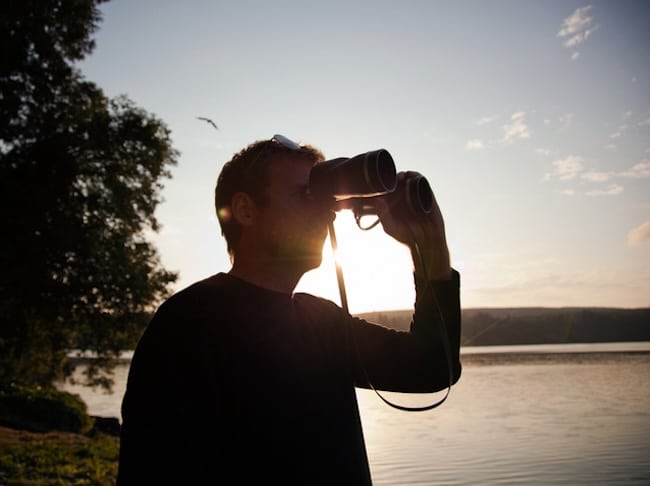
There’s a great meme that’s gone around in different forms for the last few years:

Jesse Case’s observation is one that many middle-aged adults can relate to, including myself. I can’t pinpoint exactly when it happened, but there was definitely a moment a few years back when I went from rolling my eyes at the bird pictures I’d get from both my mom and mother-in-law, to being genuinely interested and, dare I say, even excited about that goldfinch or Western tanager. Before long, my wife was making a sport of taking pictures of me taking pictures of birds:
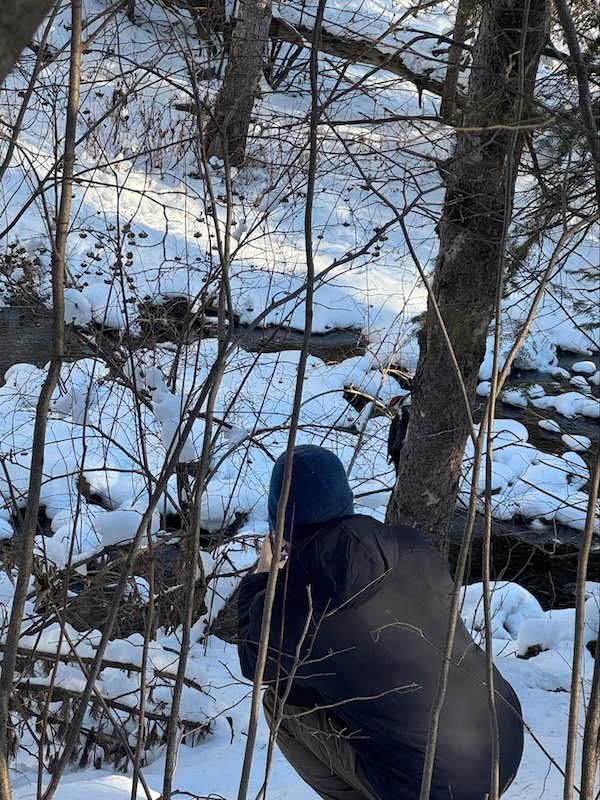
Getting acquainted with a pileated woodpecker, North America’s largest woodpecker, in Duluth, Minnesota.
Reader, you may poke fun at birding now, but I’m guessing it’s because you haven’t tried it yourself. Birds are incredibly intelligent wild animals that you see multiple varieties of on a daily basis. (Even cooler, birds are literally in the dinosaur family.)
Birding is a fantastic pursuit because it’s remarkably easy to get into and your hobby can go with you anywhere — whether you’re visiting family, going on vacation, or even just going about the course of your daily life. Birds are everywhere. And as with plenty of other pastimes, you can level it up or down according to your available time, budget, and lifestyle.
In this article, I’m going to give you the low down on dipping your toes into this satisfying hobby and hopefully convince you to give it a shot.
Tools to Get Started Birding
One of the things that’s great about birding is how low the barrier of entry is. You really don’t need much in order to start watching and identifying birds, no matter where you are. At the most essential level, there are two things I use most regularly: a quality pair of binoculars and the Merlin app from Cornell Lab of Ornithology (a world-renowned institution).
There are definitely ways to invest more — cameras, dedicated journals and guidebooks, high-end binocs, and more. For the few years that I’ve been casually birding, though, I’ve gotten by just fine with my Nocs and iPhone (for both IDing and taking pics).
Binoculars
Binoculars are your one truly essential physical piece of gear to get started birding. This 200-year-old technology allows you to scan the ground, the greenery, and the open air with the eyesight of an eagle.
While you can go cheap, I highly recommend not skimping on binoculars. My first couple pairs were real cheapos from Walmart and REI, and they just weren’t comfortable or very easy to use. When my wife finally got me a pair of Nocs as a Christmas gift, I could immediately tell the difference — somewhat to my surprise, honestly. Not only were they more comfortable, but the field of view and zoom capacity were noticeably better.
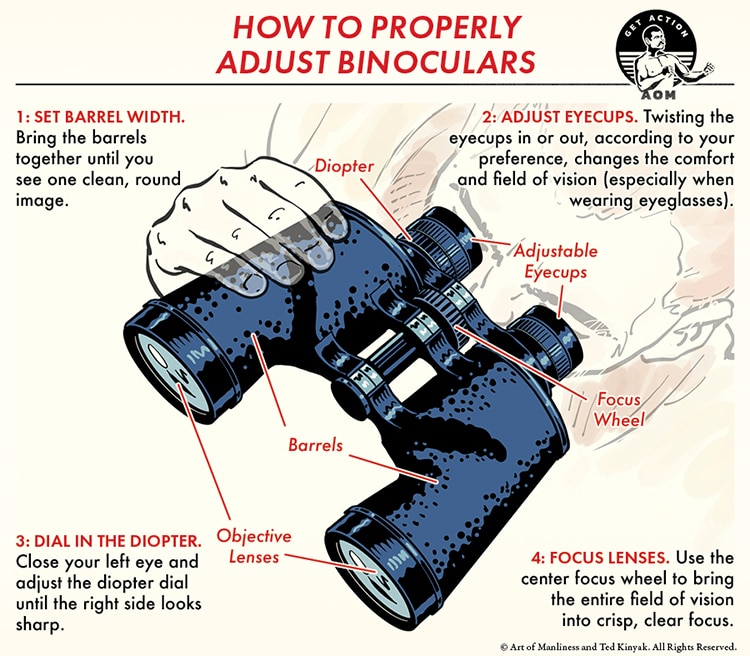
Be sure you know how to dial in those binoculars once you get them:
Merlin App
The Merlin app is one of the coolest pieces of software I’ve ever played with and is by far the most popular app in the birding community, with over 10 million active users. Whether you’re in the forest or your own backyard, you can open the Merlin app to help you ID birds in a few different ways, all of which I’ve had great luck with.
- Take a picture of the bird. Even with a blurry photo, Merlin will analyze the photo in question using cues about size, color, shape, and your location to provide its best guess. If you can see the bird, I’ve found this to be very effective, as you can compare the results with what’s right in front of you.
- Record the birdsong. If you can hear a bird, but can’t get a good picture or can’t see it at all, you can record a short audio clip and the app will ID the most likely bird(s) in real-time. I’m not kidding when I say it’s quite a thrill when you open the app at a local park and see way more species pop up than you would have thought. I think my record is 9 species from a single 60-second audio clip.
- Answer a short questionnaire. If the photo or audio aren’t working for whatever reason, you can answer a few questions about the size, color, and behavior of the bird; Merlin will then provide a short list of the best-matched birds.
It’s truly a game changer for the hobby. You’ll be amazed at how quickly you learn to identify birdsong and get to know the common species of your area. I defy you to use the app for a couple weeks and not come away totally hooked.
One way to take it up a notch is to also get the eBird app from Cornell, which acts as more of a birding log. For any birding session, whether on a hiking trail or in your own neighborhood, it allows you to track the species and number of birds spotted, which gets added to their database and will then be viewable by other folks using the app. This can be fun to check out because you’re able to see, for example, if folks recently spotted uncommon or rare birds at a local pond or park. If Merlin is a Birding 101 tool, I would call eBird a 201 tool.
Where to Look for Birds
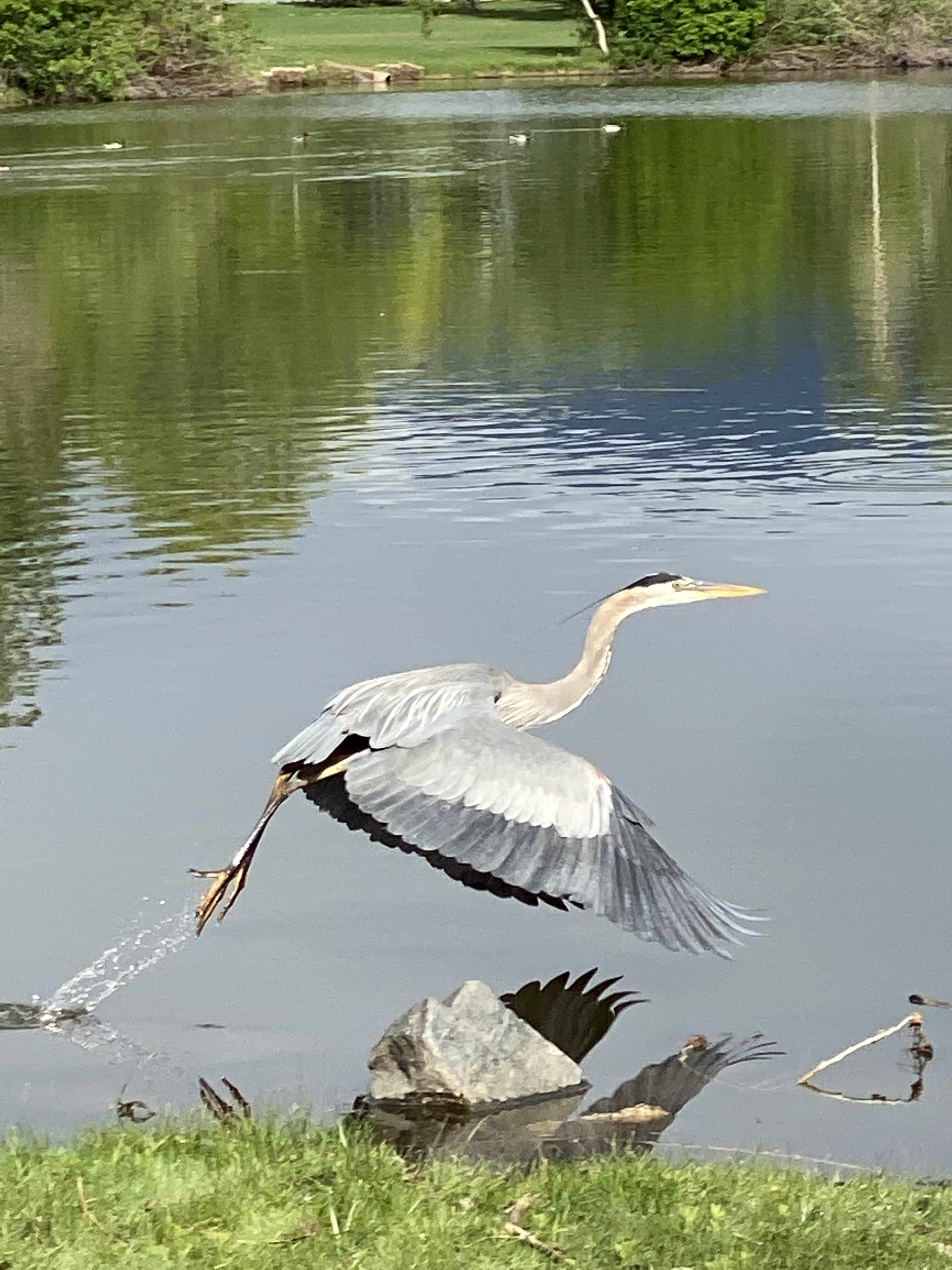
A great blue heron taking off from a small neighborhood lake in Arvada, Colorado.
Part of the low barrier to entry for birding is simply that you can do it just about anywhere. No matter where you live, even in big cities, there are birds all around you once you start paying attention. Birds are such a part of our visual and auditory experience of the world that we hardly notice them anymore — but when you stop and look around, you’ll be surprised at what you find.
That said, there are definitely birding hotspots where you can reliably find more species than others. A good rule of thumb is that anywhere there’s water, you’ll find birds. And it doesn’t take much — in addition to lakes and rivers, smaller ponds and streams will attract avian friends too. Any park or greenspace you find on a map is also a sure bet for good birding.
When you bring your kid to a park (many of which also have water nearby in some form), break out the binocs. When you’re out on a hike, open the Merlin app and see what birdsong you can catch. If there’s any greenery in your backyard, have a sit on your porch and just look around for 15 minutes.
You can get more nuanced when you factor in seasonality (spring and fall offer big migrations across numerous species), time of day (it’s not always dawn), and where things are in the breeding cycle — grab a guidebook if you’re interested in digging deeper.
The reality is that birds are everywhere, at nearly all times, when you simply start looking for them.
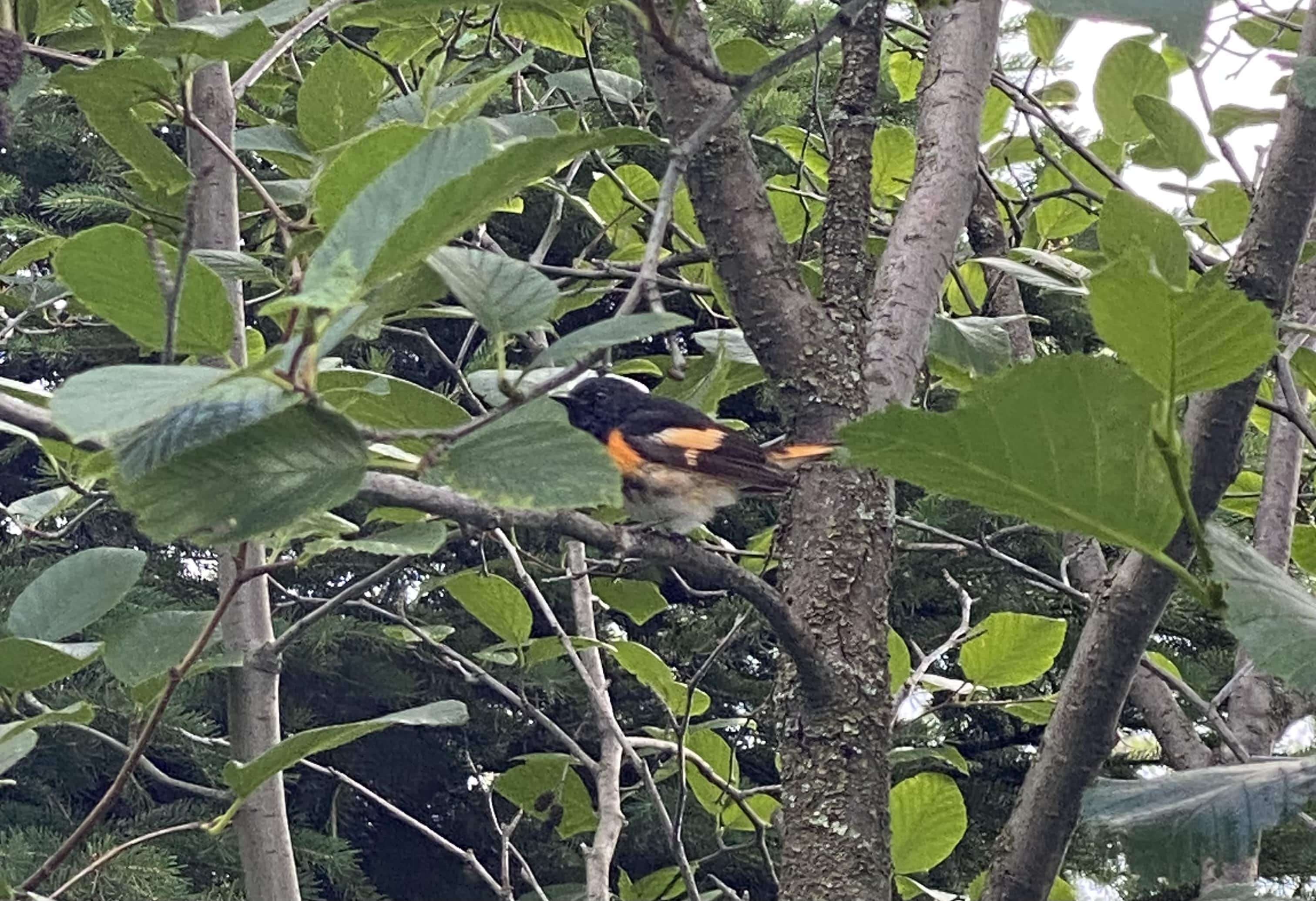
An American redstart, found in Gooseberry State Park, Minnesota.
Okay, Great, But What Do You Do?
One of the things that I initially couldn’t figure out about birding is that there’s no real outcome as a result — you’re not creating anything, you’re not in competition (not in a real way, at least) with other birders, you don’t even really have an end goal. You may keep a “life list” (simply a list of species you’ve spotted in your lifetime) or a journal/log of some kind, but that’s about it.
You’re just out there, enjoying the thing for itself.
And that’s actually the beauty of birding. In a world that’s goal-oriented and focused on results, it’s a rare activity that’s simply about the process. Birding forces you to be present — to slow down and observe the landscape around you. Birding gives you a sense of wonder at the natural world, whether you’re in some far-flung locale or just watching a chickadee at the feeder in your yard.
Grab a pair of binoculars, download the Merlin app, and do some bird watching.
This article was originally published on The Art of Manliness.


0 Commentaires